Wellness by Sound Design

How spaces, brands, and experiences can design audio that restores instead of depletes.
It can be disorienting to think that the human auditory system never fully turns off. Unlike our eyes, which we can close, our ears remain open whether we want them to or not, constantly routing signals to the brain, often before we consciously register them. We stop noticing the roar of the subway, but our bodies never stop reacting to it.
The gap between what we become habituated to and what our nervous system absorbs is a real cost of modern life.

São Paulo, Antfood's Brazilian home, is a beautiful yet chaotic and noisy city.
The Subtraction Reflex
When we think of noise and overstimulation, the typical response is subtraction. We try to block it or escape it. Silent retreats, dopamine fasts, notification-free mornings. These can all be beneficial, but they’re all stopgaps.
Silence is sold as a golden destination. We spend $250+ on Active Noise Cancellation (ANC) headphones built around the idea that “life is too loud for your nervous system.” That’s not wrong, and the relief we feel is real, but blocking out noise only helps us feel less depleted, which isn’t the same as feeling restored.
The reality is that true silence is rare and impractical for most of us, and it also isn’t what the nervous system needs most.
Three Things to Know About How Sound Affects Human Bodies
1. “I don’t hear it anymore” ≠ “my body stopped reacting.”
Stress hormone responses do show habituation with repeated noise exposure. Over time, the conscious startle fades. That habituation, however, is fragile and depends on genuine recovery gaps between exposures. Research on repeated noise stress suggests that without enough space between exposures, the body may never fully return to baseline.
For people taking the subway every day, facing the same sonic load with no gaps, the physiological stress response may never fully resolve. There’s also evidence that chronic cortisol elevation from noise suppresses neurogenesis in the hippocampus. In plain terms: the adult brain keeps producing new neurons in this region, which handles memory and spatial processing, and sustained stress hormones slow that production down. So even if our minds have moved on from the noise, the brain is paying for it long after.
2. Decision fatigue ≠ A drained battery
A popular framing treats willpower as a limited fuel source we can restore with a snack or a power nap. This hasn’t held up well under scrutiny. What seems to be closer to the truth is that extended time spent on planning and self-control correlates with reduced activity in the brain’s prefrontal regions, leading to more impulsive, less deliberate choices.
The distinction matters in practice. If it’s a battery, we refuel. But if what we need is respite from sustained attention, a supplement or a shorter meeting is only a bandage. We need actual cognitive rest.
The noise of modern life generates a constant decision load. Colleagues chatting in an open office, a notification tone, music we didn’t choose in a store: each one recruits attention we then have to actively withdraw. Research on the “irrelevant sound effect” shows this clearly: when people work with speech in the background, their working memory measurably suffers, even when they insist they’ve tuned it out. Every unconsidered sound in an environment is a small, recurring decision about whether to pay attention.
3. Silence ≠ The goal
In the 1970s, psychologists David C. Glass and Jerome E. Singer ran a now-classic series of experiments on urban noise: participants were exposed to identical levels of loud, unpredictable sound, but one group was given a button they could press to stop it, and told they shouldn’t use it. They rarely clicked the button, but their performance on cognitive tasks afterward was significantly better than participants who had no button at all. The noise experienced was the same, but having control made all the difference. The takeaway: We make better decisions when we feel that we have agency over our environments, even if we don’t use it to quiet the noise.
More recent work on perceived control and cortisol confirms this: participants who reported higher perceived control over stressors showed measurably more flexible cortisol responses and fewer psychosomatic symptoms, even when the objective stress level was identical. This suggests that the stress response isn’t just about sound, but about whether we have a say.
The same principle applies to the brain’s reward system. Preferred music triggers dopamine release in the same circuitry activated by food and other things that make us feel good. The even more actionable finding is the active/passive split: across multiple studies, people who had some level of control over the sound they were hearing showed stronger mood improvement and anxiety reduction than people who passively received the identical music. Think of the volume at a concert for your favorite band, versus the same decibels coming out of your neighbor’s apartment at 3 am. These register completely differently in the nervous system, and the research backs what most people already know experientially.
The Reframe: The Enemy is Unconsidered Sound
The real enemy isn’t sound; it’s involuntary, unpredictable, unconsidered sound. Give someone agency over what they’re hearing, and, where possible, design audio around their needs, and the same environment can flip from depleting to regulating.
Most of the sonic environments people move through every day, from offices and transit to retail, hospitality, and public space, were not designed with sound as a primary consideration. They were designed visually: sightlines, lighting, materials, wayfinding. Acoustic experience was an afterthought (if it was considered at all). Hard surfaces, open plans, glass everywhere, all choices with real physiological costs.
How It Might Be Different
A genuinely restorative built environment doesn’t mean a silent one. It means one where sound is designed in from the start, with the same rigor brought to lighting and materials. Sandy Brown Associates worked with Foster + Partners on Bloomberg’s London headquarters to give every workpoint a specific acoustic character. The building’s iconic ceiling panels were engineered to combine lighting, heating, cooling, and acoustic performance in a single module. Sound wasn’t added at the end. Instead, it helped shape the architecture.
Brian Eno understood this differently and earlier. Music for Airports, released in 1978, was designed explicitly so that listeners could choose how much attention to give it: it worked whether you were actively listening or had tuned it out entirely. It wasn’t trying to fill a space with music; it was trying to give people a relationship to sound they could control.
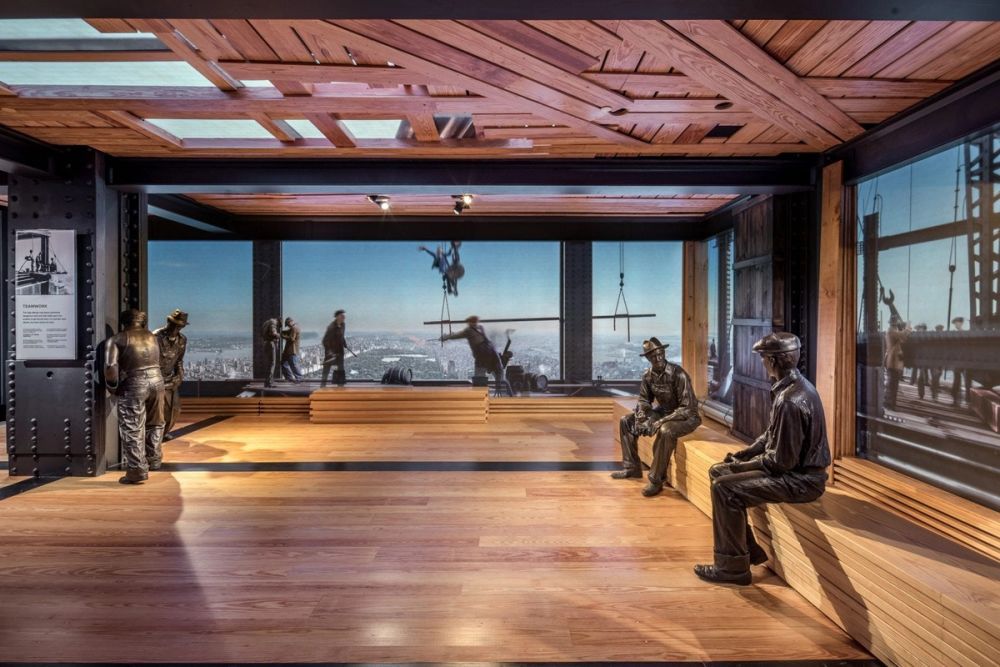
Antfood’s work at the Empire State Building took an experiential approach with the same principle. The team designed a cohesive audio experience across 35,000 square feet of installations – including a fully immersive theater – helping guide visitors as they make their way up to the observatory while informing them of the building’s history and its importance as a New York cultural landmark. Sound wasn’t installed at the end; it was designed as wayfinding, narrative, and atmosphere all at once, both interactive and empathetic to listeners’ needs.

The Great Dictator, an installation that premiered at SXSW 2025, pushed this to an extreme. Participants stepped up to a podium and delivered some of history’s most charged speeches (Malcolm X, Reagan, Mamdani), with their voices and likenesses inserted into archival footage while an AI-generated crowd reacted in real time to how they spoke. While the sonic environment was overwhelming by design, having agency and responsive engagement made visitors feel empowered rather than depleted.
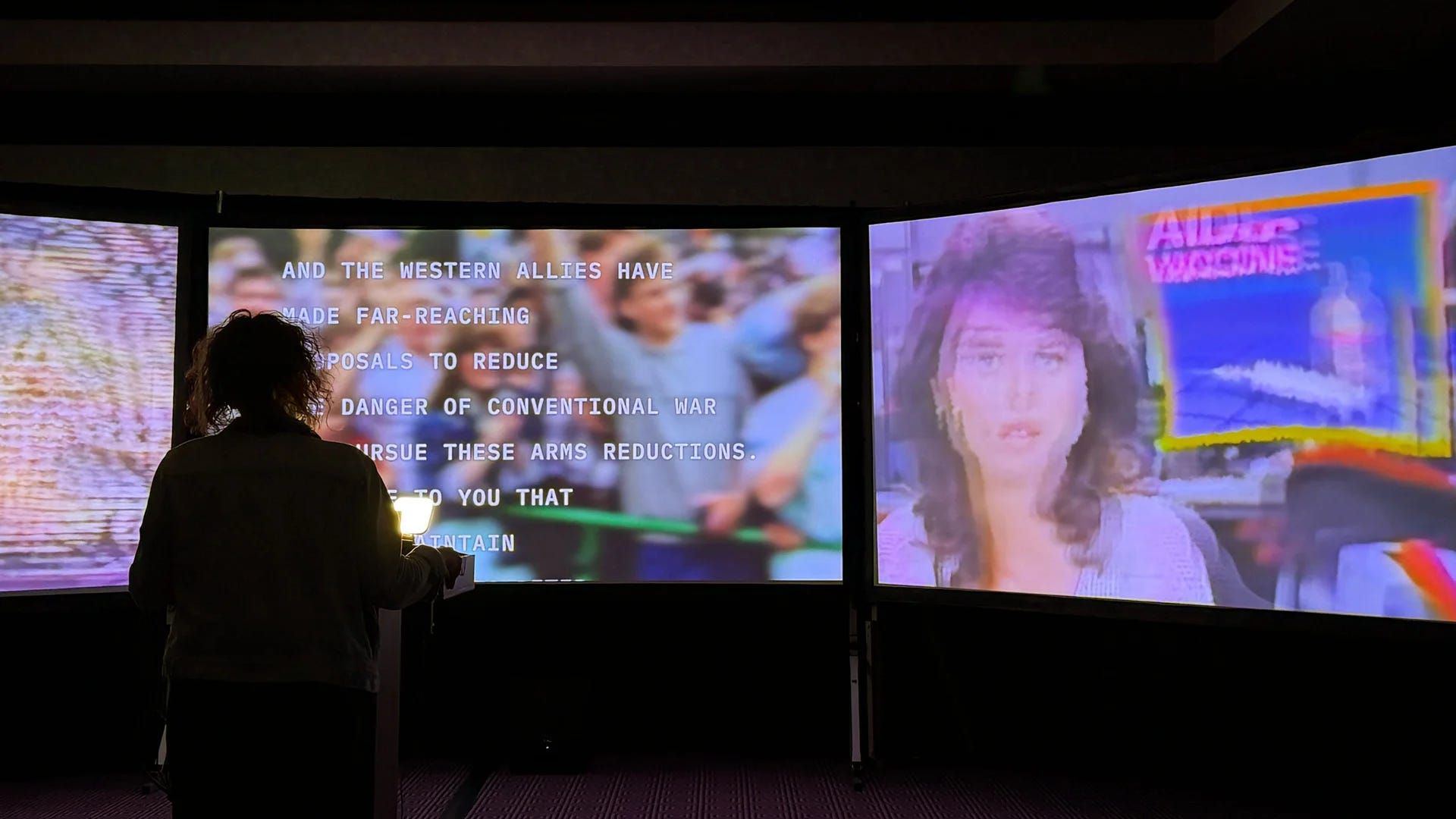
Photo by Marty Swant. Deepfakes are warping reality. This AI project Turns Them Into a history lesson. .
Antfood’s work starts from the same two principles: audio should be considered from the beginning of the design process, not bolted on at the end, and giving people agency over their sonic environment creates more meaningful engagement. We can’t remove the sirens or the ambient hum of shared spaces, but we can design environments that account for them and give people more control over how they experience sound.
Earning Credit, Not Just Lowering the Tax
The goal was never a quieter New York, or a quieter office, or a quieter commute. Those are useful, worth pursuing, but not sufficient. The more interesting design question is what it would mean to give people real agency over the sonic layer of their lives. We believe environments should be designed around human needs, with the understanding that having control over the sound around us isn’t an aesthetic preference, but a fundamental requirement.
Similar content
Sound Strategy: How to Talk Music For Non-Musicians
by Marina Kagan

Hackable Audio: Crafting Sonic Puzzles for Google
by Charlie Blasberg

Sound Is the Last Unfair Advantage in Branding. Don't Waste It.
by Wilson Brown